

When the penalty shootout wrapped up in Rabat and DR Congo sealed their ticket to the intercontinental playoffs, the immediate reaction across social media was sheer, unadulterated shock.
“How does a team with Victor Osimhen, Ademola Lookman, and Victor Boniface miss an expanded, 48-team World Cup?”
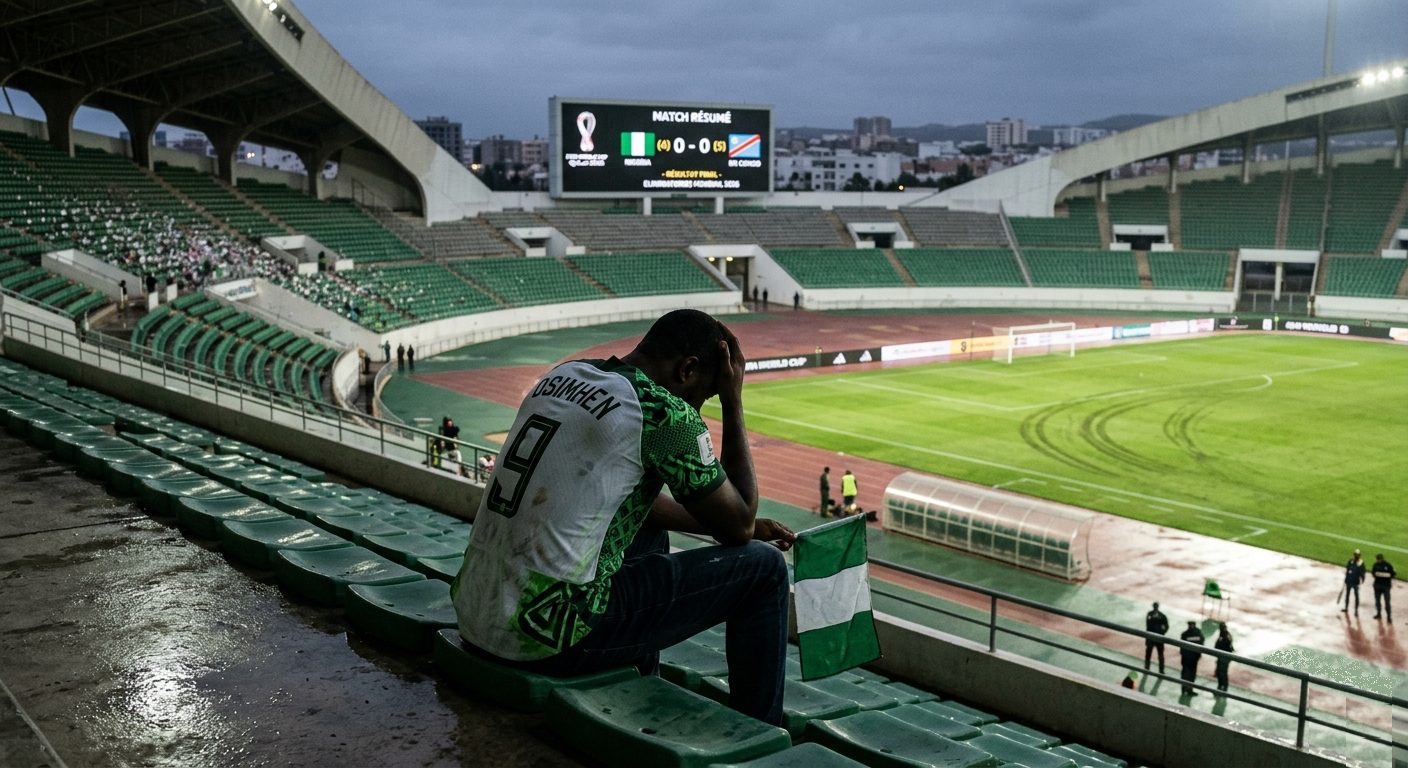 On paper, it sounds like a national tragedy. But if you’ve actually been watching the Super Eagles over the last few years, this wasn’t a shock at all. It was the logical conclusion of a system reliant entirely on individual rescue acts rather than collective structure.
Nigeria didn’t fail to qualify because they lacked talent. They failed because talent alone is no longer enough to dominate African football. Here is why the Super Eagles’ absence from the 2026 World Cup is the least surprising storyline in African sports.
1. The "Paper Tiger" Midfield Problem
Nigeria has an embarrassment of riches in attack. You could arguably field two different frontlines that would walk into almost any team in the world. But football matches are won and lost in the engine room, and Nigeria’s midfield has been a glaring vulnerability for years.
The squad structure was heavily top-heavy. While the NFF continuously integrated dazzling wingers and elite European league strikers, the midfield lacked progressive passers and controllers. Too often, the tactical plan devolved into "give the ball to the attackers and hope they create magic." When opposing teams packed the middle and cut off the supply lines, the Super Eagles looked completely devoid of ideas.
2. Chronic Administrative Instability
Success on the pitch requires continuity off it, and the Nigerian Football Federation (NFF) has historically struggled to provide that. The qualifying campaign was a masterclass in instability. Changing coaching staff, late tactical pivots, and systemic organizational distractions meant the team never established an actual identity.
By the time coach Eric Chelle was tasked with steadying the ship, he inherited a fragmented situation. High-level international football rewards long-term planning and strict structural systems. Nigeria tried to improvise its way through a grueling qualification process, and the cracks finally gave way under pressure.
3. The Levelling of African Football
There are no more "minnows" in African football. The narrative that a heavyweight nation can just turn up and claim three points based on reputation is completely dead.
Teams like Benin and South Africa took points off Nigeria in the group stages because they were highly organized, tactically disciplined, and played with a cohesive domestic and international identity. DR Congo didn't blink in the playoffs because they knew exactly who they were as a collective. Nigeria, conversely, looked like a collection of brilliant individuals trying to get on the same page in real-time.
The Silver Lining?
If there is any comfort for Nigerian fans, it’s that this failure forced a mirror up to the program. The immediate response at the Africa Cup of Nations (AFCON) earlier this year—where a highly motivated Super Eagles side looked organized and dominant, securing emphatic wins like the 2-0 masterclass against Algeria—showed what happens when these players finally lock in and play with unified discipline.
Missing out on the World Cup is a massive blow to the players' global profiles and the vibrant culture Nigerian fans bring to the tournament. But hopefully, this harsh reality check is exactly the structural catalyst the NFF needs to stop relying on individual brilliance and start building an actual team.